Lime Mortar in Gothic Vaults of Italian Cathedrals
Gothic ribbed vaulting, developed in Italian cathedral construction from the late twelfth century onward, relies on a mortar matrix that must remain flexible enough to accommodate minor seasonal movement while providing long-term cohesion at the intrados and extrados surfaces. Analysis of surviving original mortars from Milan, Siena, Orvieto and Naples reveals consistent formulations centred on aerial lime with pozzolanic additions — a tradition directly inherited from Roman opus caementicium and maintained through medieval practice.
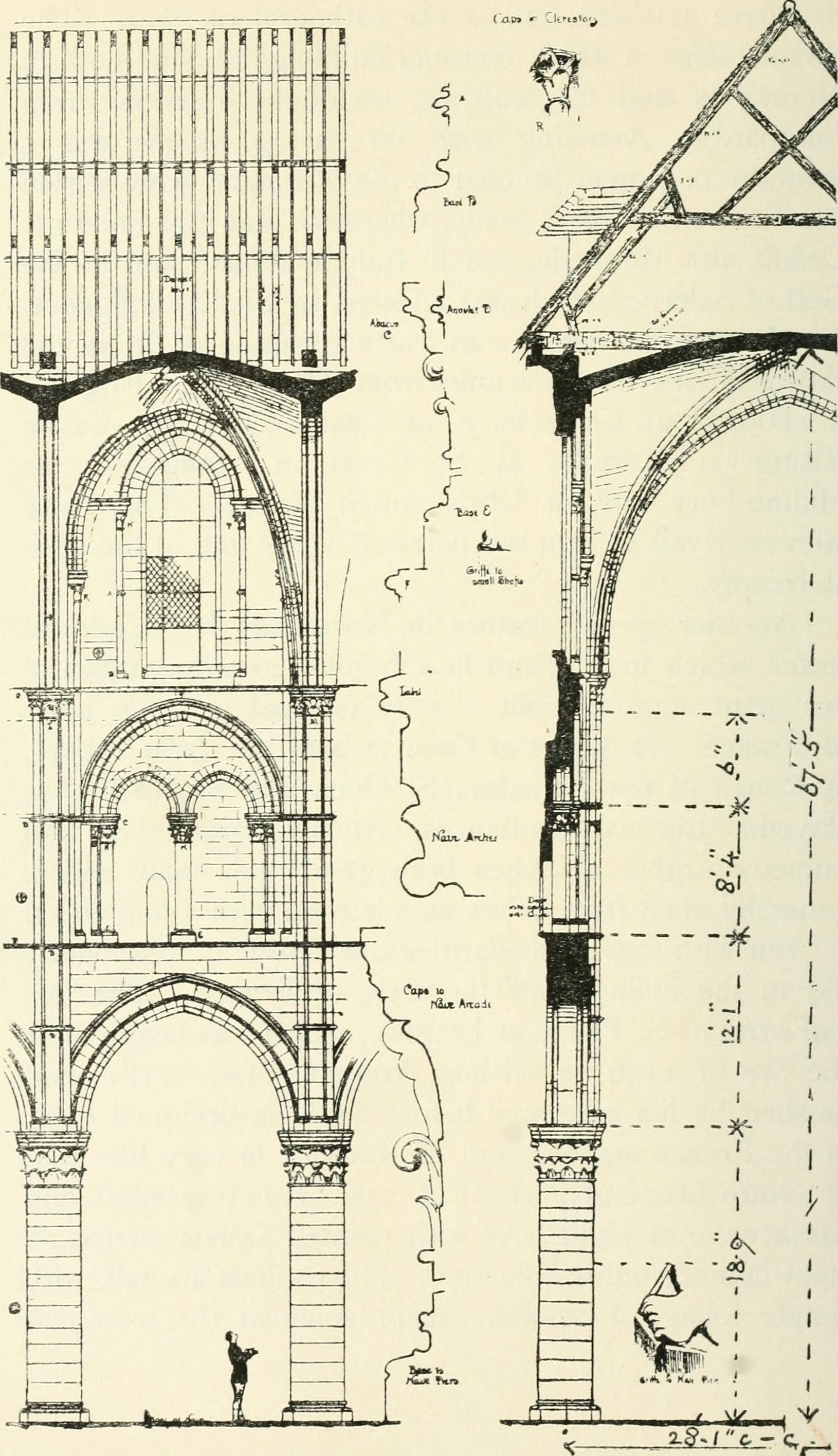
Gothic architectural details from France, England and Italy, 1915 illustration. Wikimedia Commons, public domain.
Composition of Original Mortars
Mortar analysis conducted on samples from Italian Gothic cathedrals using optical microscopy, X-ray diffraction (XRD) and scanning electron microscopy with energy-dispersive X-ray spectroscopy (SEM-EDX) indicates the following characteristic profile:
- Binder: Aerial lime (calcite-dominant, low magnesia content) with varying proportions of hydraulic components — typically crushed brick or tile (cocciopesto), volcanic ash (pozzolana) or ground ceramic.
- Aggregate: Locally sourced river sand, with grading and roundness reflecting the specific catchment. Crushed stone fines appear in some Tuscan samples.
- Binder:aggregate ratio: Generally between 1:1.5 and 1:3 by volume, varying by function — bedding mortars tend toward leaner mixes than pointing mortars.
- Additives: Animal hair fibres (for crack resistance) are documented in intrados plaster layers; linseed oil coatings are found on some extrados surfaces.
The hydraulic component content is significant because it governs early strength development and moisture resistance. Vaults subjected to roof drainage or condensation — common at the junction of nave and transept — typically show higher cocciopesto proportions in original mortars, suggesting empirical adaptation by medieval masons to anticipated moisture exposure.
Deterioration Patterns in Vault Mortars
Surveys of Gothic vaulting in Italian cathedrals identify three recurring deterioration patterns that guide repair strategy:
Joint Recession and Loss of Cohesion
Centuries of carbonation and repeated wetting-drying cycles cause bedding mortars to recede behind the ashlar face. This exposes masonry units to differential weathering and allows water to penetrate the vault's rubble fill. In ribbed systems, recession along rib-web junctions is particularly common and, where left unaddressed, progresses to spalling of adjacent stone units.
Soluble Salt Crystallisation
Efflorescence and sub-florescence of gypsum, halite and calcium nitrates occur where rising or penetrating moisture evaporates within the masonry section. Gothic vaults in churches with below-grade crypts or insufficient roof drainage show elevated salt concentrations at mid-vault and crown positions. Salt management — desalination poultices and elimination of moisture source — precedes mortar repair in affected areas.
Cracking Along Rib-Web Interface
Differential movement between the ribs (ashlar-built, stiffer) and infill webbing (rubble or thin brick panels, more flexible) produces crack patterns running parallel to the rib profile. These cracks are monitored over at least one annual cycle before repair to distinguish active from stable movement, as intervention into an actively moving structure may accelerate deterioration.
Repair Mortar Formulation
Compatible repair mortars are formulated to match the original in three key parameters: strength, porosity and colour/texture. Matching formulations developed under ICR protocols follow a staged process.
Analysis and Recipe Development
Original mortar fragments are disaggregated in dilute hydrochloric acid to separate insoluble aggregate from the binder fraction. Aggregate grading is determined by sieve analysis; binder type is characterised by XRD of the acid-insoluble residue and the remaining calcium carbonate fraction. This allows reconstruction of an approximate original recipe, which is then adjusted for available materials.
Common Repair Mix Profiles
- Bedding repoint, low-moisture zone: NHL 2 (1 part) : washed river sand, 0–4 mm (2.5 parts) : brick dust (0.5 parts), mixed to stiff consistency.
- Bedding repoint, elevated moisture exposure: NHL 3.5 (1 part) : sand 0–4 mm (2 parts) : cocciopesto (0.5 parts), slightly wetter mix for improved workability in confined joint access.
- Rib-web crack fill: NHL 2 (1 part) : fine aggregate 0–2 mm (1.5 parts), applied by spatula in thin coats to avoid shrinkage cracking during carbonation.
Pre-blended lime mortars conforming to EN 998-2 (masonry mortar) are used on some projects where site batching consistency is difficult to maintain. Product specifications are verified against original analysis before approval. Accelerated carbonation tests on trial panels confirm long-term colour match.
Application Conditions
Application temperature must remain above 5°C throughout the curing period. Lime mortars are susceptible to freeze damage before initial carbonation is complete — a process requiring several weeks in cool conditions. Work on Gothic vault surfaces is typically scheduled from late spring to early autumn to avoid frost risk. Freshly applied mortar is protected from rapid drying by damp hessian sheets or fine-mist humidification where ambient relative humidity falls below 50%.
Monitoring Post-Repair
Crack monitoring gauges are installed across stabilised cracks and read at six-month intervals for at least two years after repair. This confirms that repaired joints are not being re-opened by residual structural movement. Results are submitted as part of the post-intervention report required by the competent Soprintendenza.

Gothic architectural cross-sections showing vault geometry, 1915. Wikimedia Commons, public domain.
References
- ICR — Istituto Centrale per il Restauro, Rome
- ICOMOS — Venice Charter, 1964
- EN 998-2:2016 — Specification for mortar for masonry
- EN 459-1:2015 — Building lime: definitions, specifications and conformity criteria
- UNESCO WHC — Cathedral of Santa Maria del Fiore, Florence